Wednesday, June 06, 2007

Behold These Words, And Despair

Cindy Sheehan, mighty voice of the anti-war movement, recently resigned from it. Her words, as always, are both insightful and impossible to argue with (unless you still believe that George Bush has your back), so here they are: (note the impossibility of accomplishing anything meaningful in this country due to the relentless partisanship of both political parties)(emphasis Chaos'):

"I have endured a lot of smear and hatred since Casey was killed and especially since I became the so-called "Face" of the American anti-war movement. Especially since I renounced any tie I have remaining with the Democratic Party, I have been further trashed on such "liberal blogs" as the Democratic Underground. Being called an "attention whore" and being told "good riddance" are some of the more milder rebukes.

I have come to some heartbreaking conclusions this Memorial Day Morning. These are not spur of the moment reflections, but things I have been meditating on for about a year now. The conclusions that I have slowly and very reluctantly come to are very heartbreaking to me.

The first conclusion is that I was the darling of the so-called left as long as I limited my protests to George Bush and the Republican Party. Of course, I was slandered and libeled by the right as a "tool" of the Democratic Party. This label was to marginalize me and my message. How could a woman have an original thought, or be working outside of our "two-party" system?

However, when I started to hold the Democratic Party to the same standards that I held the Republican Party, support for my cause started to erode and the "left" started labeling me with the same slurs that the right used. I guess no one paid attention to me when I said that the issue of peace and people dying for no reason is not a matter of "right or left", but "right and wrong."

I am deemed a radical because I believe that partisan politics should be left to the wayside when hundreds of thousands of people are dying for a war based on lies that is supported by Democrats and Republican alike. It amazes me that people who are sharp on the issues and can zero in like a laser beam on lies, misrepresentations, and political expediency when it comes to one party refuse to recognize it in their own party. Blind party loyalty is dangerous whatever side it occurs on. People of the world look on us Americans as jokes because we allow our political leaders so much murderous latitude and if we don’t find alternatives to this corrupt "two" party system our Representative Republic will die and be replaced with what we are rapidly descending into with nary a check or balance: a fascist corporate wasteland. I am demonized because I don’t see party affiliation or nationality when I look at a person, I see that person’s heart. If someone looks, dresses, acts, talks and votes like a Republican, then why do they deserve support just because he/she calls him/herself a Democrat?

I have also reached the conclusion that if I am doing what I am doing because I am an "attention whore" then I really need to be committed. I have invested everything I have into trying to bring peace with justice to a country that wants neither. If an individual wants both, then normally he/she is not willing to do more than walk in a protest march or sit behind his/her computer criticizing others. I have spent every available cent I got from the money a "grateful" country gave me when they killed my son and every penny that I have received in speaking or book fees since then. I have sacrificed a 29 year marriage and have traveled for extended periods of time away from Casey’s brother and sisters and my health has suffered and my hospital bills from last summer (when I almost died) are in collection because I have used all my energy trying to stop this country from slaughtering innocent human beings. I have been called every despicable name that small minds can think of and have had my life threatened many times.

The most devastating conclusion that I reached this morning, however, was that Casey did indeed die for nothing. His precious lifeblood drained out in a country far away from his family who loves him, killed by his own country which is beholden to and run by a war machine that even controls what we think. I have tried every since he died to make his sacrifice meaningful. Casey died for a country which cares more about who will be the next American Idol than how many people will be killed in the next few months while Democrats and Republicans play politics with human lives. It is so painful to me to know that I bought into this system for so many years and Casey paid the price for that allegiance. I failed my boy and that hurts the most.

I have also tried to work within a peace movement that often puts personal egos above peace and human life. This group won’t work with that group; he won’t attend an event if she is going to be there; and why does Cindy Sheehan get all the attention anyway? It is hard to work for peace when the very movement that is named after it has so many divisions.

Our brave young men and women in Iraq have been abandoned there indefinitely by their cowardly leaders who move them around like pawns on a chessboard of destruction and the people of Iraq have been doomed to death and fates worse than death by people worried more about elections than people. However, in five, ten, or fifteen years, our troops will come limping home in another abject defeat and ten or twenty years from then, our children’s children will be seeing their loved ones die for no reason, because their grandparents also bought into this corrupt system. George Bush will never be impeached because if the Democrats dig too deeply, they may unearth a few skeletons in their own graves and the system will perpetuate itself in perpetuity.

I am going to take whatever I have left and go home. I am going to go home and be a mother to my surviving children and try to regain some of what I have lost. I will try to maintain and nurture some very positive relationships that I have found in the journey that I was forced into when Casey died and try to repair some of the ones that have fallen apart since I began this single-minded crusade to try and change a paradigm that is now, I am afraid, carved in immovable, unbendable and rigidly mendacious marble.

Camp Casey has served its purpose. It’s for sale. Anyone want to buy five beautiful acres in Crawford , Texas ? I will consider any reasonable offer. I hear George Bush will be moving out soon, too...which makes the property even more valuable.

This is my resignation letter as the "face" of the American anti-war movement. This is not my "Checkers" moment, because I will never give up trying to help people in the world who are harmed by the empire of the good old US of A, but I am finished working in, or outside of this system. This system forcefully resists being helped and eats up the people who try to help it. I am getting out before it totally consumes me or anymore people that I love and the rest of my resources.

Good-bye America ...you are not the country that I love and I finally realized no matter how much I sacrifice, I can’t make you be that country unless you want it.

It’s up to you now.

Monday, June 04, 2007

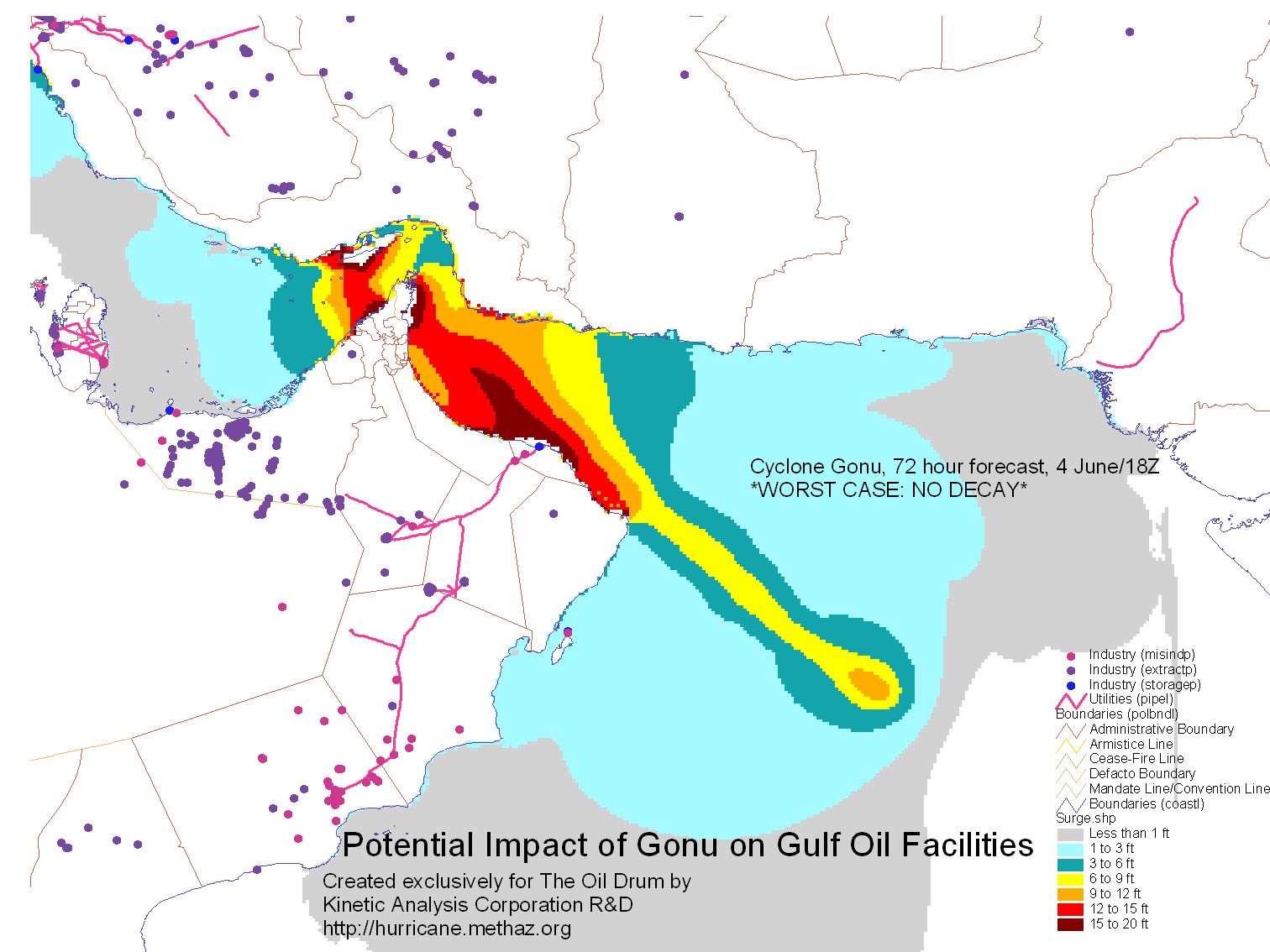
Unique Cyclone Threatens Oman, Persian Gulf

Never seen this before, not ever....there's oil production facilities out there, right? Check out this link, perhaps wonder why it wasn't on today's CNN.

Saturday, June 02, 2007

Why Are Gas Prices So High? An Insider's Explanation

You can read a lot of, well, untruths about current high(er, but still not nearly high enough) gas prices in the Empire. Rarely will you hear actual explanations, backed up by "true" facts, and most especially not in the MSM. Here on the Edge, though, you can catch the real scoop simply by clicking on this fine exposition by The Oil Drum contributor Robert Rapier. An employee of an (unnamed) oil company, this person has a keen focus and his blog, R-squared, is certainly worth a read as well, if you find yourself wanting more. Contemplate the explanation given and consider emailing it to the next fool that sends you one of those ridiculous emails recommending a "boycott" of the corner gas stations.

Friday, June 01, 2007

The Upside of Down Online!!

You can now read (you can read, can't you?) the entire book, The Upside of Down, the brilliant and insightful Thomas Homer-Dixon, who has quite obviously studied other authors mentioned in Chaos' bibliography (in fact, that's a fun exercise...to figure out which ones), and more than any recent author, is skilled in presenting the issue of why our civilization, which depends mightily on huge flows of energy, is at risk for catastrophic failure. A long and extremely important read.
(Update) The link has now been removed, for unknown reasons (copyright, perhaps? giving away books is not a good business model), but not before Chaos had a chance to finish it. The work is outstanding, so much so that Chaos will buy it anyway and lend it out to local readers. The usual entry into this field of study is technical and difficult to peruse, but Homer-Dixon's work is imminently readable for non-experts. Chaos cannot recommend this book enough.

Thursday, May 31, 2007

The 55 MPH Speed Limit Revisited

Uh oh, someone else has now thought of this...remember when Chaos suggested that a prudent nation would be doing something really simple and easy, like lowering the speed limit to 55mph, in response to the impending energy shortage? Well, Chaos would now bow to a much more eloquent writer on the subject, but would also have to point out that the citizens of the Empire are still no more likely to do this than stand on their heads in heavy freeway traffic....nice work, though.

Two New Houses


In the news today are a couple of interesting examples (from both ends of the spectrum) of some "alternative" houses" you might consider, if you are certain that you are in a locale you have decided has a decent chance of surviving the coming energy apocalypse. The first is a conventional-looking 2400 sq foot property located in (where else?) California, whose owners have contrived to have it completely off the "grid" due to their solar panels, battery banks, and inverters. Interesting, if somewhat conventional. Next up is the fascinating idea of building a house using living trees, pictured above. The thing appears to be a mere concept (no customers yet, but maybe soon, in Cali...) but who wouldn't want to live in an actual treehouse? Human ingenuity knows no bounds (well, except for physical limits, which the species seems to have trouble with).

Where Oil Comes From...A Story in Pictures

Did you wake up this morning wondering where the gasoline in your vehicle originated? Didn't you spend many sleepless nights thinking about where oil comes from? Did it just get deposited in the ground by magic or wasn't there something about dinosaurs? Chaos knew you did, and now there's an actual video (yes! no reading! because people just learn better with pictures!) showing just exactly how oil got made, many long years ago. Although it is quite long, with many parts, Chaos recommends you view it. Maybe it will change your perspective; who knows?

Introduction to Tom Whipple

This writer, who scribes for the Falls-Church News Press, of all places, is a consistent and effective reporter of the effects of peak oil and the Empire's lack of response to it. Today's piece, reproduced here in its entirety since Chaos has become aware of just how difficult it is to 'click' on a 'link,' gives one both a sense of the scope of the changes necessary to deal with the looming catastrophes and the ever-onrushing deadlines which will not even be acknowledged until the last minute. Something for both doomers and the kumbaya crowd, in other words. Here's the article:

"News on the gasoline stockpile situation was delayed this week due to the Memorial Day holiday. As gasoline consumption figures over the long weekend won’t be available until the middle of next week, we may get a better insight into prospects for this summer then. While waiting, however, it seems like a good time to start thinking a bit about the years ahead and what we should be doing to get ready for them.

There are two areas of energy consumption we, as individuals, can do something about: transportation and buildings. The cost and availability of our food is something that few of us have much control over. If food becomes too expensive, then we simply reduce or forego eating out; reduce our use of prepared, packaged, and expensive foods; or even reduce the quantity we consume until the costs of food meet our budget.

Commercial use of energy to make and distribute things will be sorted out by the market – here again, there is little most of us can do to effect change other than generally reducing consumption either because we are trying to save the world’s resources, or, more likely, we simply can’t afford to pay what stuff is going to cost.

Unaffordable gasoline will affect each of us differently depending on how dependent we are on our automobile and what our alternatives are. In the U.S. we have something on the order of 210 million cars and light trucks in service and, even if the resources are available to replace a fleet of this size, it will be many decades before they can be replaced with vehicles that use little or no gasoline. Worldwide, the situation is even worse.

It probably won’t be too long before we figure out whatever supplies of motor fuel are available will be better spent on growing and distributing food and maintaining vital-to-civilization systems such as water, sewers, electricity, and communications rather than being burned in private cars. For the immediate future though, unaffordable gasoline will be coped with through a combination of increased public transit and a lot more ride sharing.

Soon, there will be lots of room for changes in public policy as we tackle the job of reworking our transportation systems. For now, we are not ready to think seriously about changes, for the reality of imminent oil depletion is not widely recognized. Another three or four dollar increase in gasoline prices should do the trick.

Buildings, however, are another matter -- be they offices, factories, commercial space, or homes. In the developed world, most use prodigious amounts of energy. Although our electricity and natural gas bills currently are not increasing as fast as gasoline prices, price increases for other forms of energy won’t be many years behind. Unlike a gas guzzler which can be parked, used infrequently, or scrapped for a more efficient vehicle, few of us will have the opportunity to replace our buildings for more efficient ones.

A couple of hundred years ago most homes were heated and lit by wood plus a little candle wax. That’s obviously not going to work anymore. My guess is that most people’s access to firewood, if any, would be sufficient for a couple of days or, at best, a couple of weeks. For awhile, there will be a rush to huddling around electric heaters, but just as natural gas, oil, propane will soon be too expensive to for many to afford, large amounts of electricity will not be far behind. We are going to have to transition to solar and maybe a little wind energy to control our personal climates.

One of the redeeming features of our current living and work place arrangements is that we waste prodigious amounts of energy in heating, cooling and lighting them, so that there is a lot to be saved. We all know by now that eliminating incandescent bulbs and moving first to compact fluorescents and then, as they become more affordable, to LED’s most of the lighting costs in homes and offices can be eliminated.

Equally big jumps in household efficiency can be achieved by disconnecting clothes dryers and going back to clothes lines. Pulling the plug on the central air would be the third big energy saver.

Given the trends in fossil fuel availability, it is clear that our goal will have to be zero net energy for all our inhabited buildings. This means that the preponderance of the energy used in buildings will soon have to come from the sun, wind, water power, and perhaps a little biomass and will not be delivered in by pipe and power lines or in trucks.

The course from our current building stock to highly efficient ones will be long and difficult. Starting on this course is not difficult or particularly expensive. Plugging air leaks, adding some more insulation, and perhaps improving the window and doors is a good place to start provided one knows what to do, where to start and is physically and financially capable of taking action in the face of rapidly rising energy costs.

Later steps on the way to zero net energy buildings, such as major insulation and window upgrades, solar heating and electric panels, new heating and air conditioning equipment will be very expensive and perhaps unaffordable for many in an inflation-wracked world of depleting oil.

It is at this point that governments at all levels will need to get involved. First they must recognize that the bulk of our inhabited buildings will need to be overhauled to be useful in a world of very high priced energy. Cost/benefit ratios for steps to improve the efficiency for nearly every existing building need to be worked out.

Building codes will need massive overhaul to prevent further construction of buildings that are premised on cheap energy and that will have a very short useful lifetime. Construction of sub-divisions that do not take into account optimum sun angles should come to an immediate halt. Obsolete laws and covenants that frown on efficiencies from clothes lines to solar panels must be abolished as soon as possible.

There is much to be done and the time is growing short."


Tuesday, May 29, 2007

Global Heating Review

Well, here we are again...with yet another "ice melting" story. Chaos is somewhat loathe to present such repetitive material, but it seems to recur again and again. Well, at least the National Geographic story that this derives from is accessible (it has pictures! cool!) and thought-provoking. Be a dear and actually read the link. Oh wait, sorry...this article is just someone's opinion. Never mind.

Saturday, May 26, 2007

Another Sign of Peak Oil

Also from the "you just can't make this stuff up" department...subtitled "Scootin on the Strip," seems able-bodied visitors to Las Vegas have taken to using scooters meant for the handicapped to navigate the oh-so-long four mile Strip. Chaos could probably make some remarks about how this reveals the true American character and why the nation will continue its fossil fuels fiesta as long as possible, but why bother? It pretty much speaks for itself, and really isn't all that shocking in the context of the entire ridiculous and wasteful insanity any thinking sentient being can discern just by looking around.

It Really Is the Health Care, Stupid

Ok, not really, and of course this has been covered before here on the Edge, but just to show faithful readers that Chaos is not just blowing smoke, here comes a seemingly objective and unbiased look at the American healthcare system, compared to five other Western nations. It should surprise no one by now that, among Germany, Great Britain, Australia, Canada , and New Zealand, the US ranks last or next to last in all categories evaluated save one subcategory (the categories were quality care, access, efficiency, equity and healthy lives). Of course, the US leads all nations in per capita expenditures in healthcare, so apparently spending money on the problem isn't working. Note: the link contains both the executive summary, which should be enough for the casual reader, and a pdf link to the entire report. The report was mentioned in today's New York Times, in the form of a guest columnist editorial. Chaos' own editorial spin on this is that the US public gets the healthcare it deserves, i.e., since there are many fine examples of alternative (and better) ways to address the issue, it isn't lack of knowledge, but lack of caring or will, if you will, which prevents the people of the nation from demanding better options.

Monday, May 21, 2007

Where To Live, The Continuing Series

Chaos has mentioned previously that thinking beings, particularly those young ones who reside in the Empire, may want to consider relocating to a safer, happier, less-prone-to-collapse country. Here's an interesting dimension to get one started: the 2006 Corruption Perceptions Index, which ranks countries according to their perceived level of corruption. If nothing else, this makes for interesting reading. More thoughts on emigration tomorrow.

Wednesday, May 09, 2007

Overshoot Primer: The Elephant in the Room

For those who have not the time to read the classic "Overshoot" but would like to know what terms like "carrying capacity," "sustainability," "dieoff" and of course, "overshoot" mean, and why overpopulation is really the problem we need to address, but won't (of course, those who have viewed Prof. Bartlett's video will already be familiar with this issue), this post from The Oil Drum (by contributor Guilder Guider) is probably the best short tutorial. If you have time, you might read the many and varied comments at the end, and note how uncomfortable some persons are with these ideas and how they attempt, vainly, to dispute the principles. Very entertaining, and sobering. It is, of course, exactly why any "solutions" will be fruitless.

Investment Ideas From Matt Simmons

Those in the know about Peak Oil, know Matt Simmons....energy investment banker, and author of vastly important book on Saudi oil reserves (hint: they aren't as large as stated, and are probably declining more rapidly). For those readers who are interested in investment tips, here (pdf file) is Simmons' latest slide and bullet point presentation. Even if you have little or nothing to invest, the peak oil points are significant.

Saturday, May 05, 2007

Collapse Scenarios Revisited, Defined

Chaos has mentioned Dmitry Orlov several times in the past, and in truth there is not very much that is completely new in this latest presentation of the US v. the Soviet Union; nevertheless, it is still a highly entertaining presentation (with slides and bullet points), which gives one an interesting perspective of someone outside the vast US media bubble. Pursuing the theme a bit more is this summary of approaches to collapse in the online encyclopedia Wikipedia; an entertaining page for those who are interested in the concept. Finally, here is a fascinating piece on the spirituality of collapse which incorporates some Buddhist and Jungian principles in assessing the likely effects of such an event.

Friday, May 04, 2007

Survey Says....US Public Infantile, Delusional

To continue on yesterday's theme (or perhaps embroider it just a bit), as gas prices head up, the clueless population of the Empire starts to whine and complain. Something must be done, they say. Of course, by "something" they mean "something that doesn't cause me pain or cost me money." If you think Chaos is being oh, a little mean, perhaps, consider these findings from a national survey undertaken for the Civil Society Institute:

"The vast majority told researchers from Opinion Research Corp. that they want sharp increases in automotive fuel economy standards, as well as new windfall profit taxes on oil companies, with the proceeds used to develop alternative fuels and to reduce dependence on unstable Mideast oil supplies." Although Americans can talk the talk, recent history demonstrates, unfortunately, that they don't walk the walk:

"Whether consumers will actually adjust their driving behavior is an open question. In the past, despite rising prices, American motorists have tended to gulp, complain, and continue their old patterns. Despite the publicity given to hybrids, such as the Toyota Prius, they still make an insignificant dent on the sales charts. And as Solo noted, during the news conference, there are now fewer cars rated at 40 mpg than just five years ago.

'People want (their) problems solved for them,' conceded Civil Society spokeswoman Ailis Aaron Wolf."


Need Chaos remind readers at this point that this national infantilism and cluelessness is likely to be a hindrance when oil begins to decline?

Thursday, May 03, 2007

The World Capitol of Ignorance Marches Determinedly Backward

For those who have been paying attention to the US gasoline situation recently(the best place to follow this is, of course, The Oil Drum), it is apparent that this summer will be a painful one. Gasoline stocks are at historic lows, while consumption is up, and refining capacity remains very tight. All these signs, on the eve of the "summer driving season," (what a ridiculous concept: it's summer! let's go drive!) point to ever higher gasoline prices in the next few months. Surely in a city of approximately 1.5 million, someone other than Chaos would have noticed that more people, houses, and cars is not a particularly good idea. But wait! No, it appears the region is undergoing yet another unsustainable round of explosive, sprawling growth, as evidenced by this thoughtless article: "Population is booming in that quadrant of the county, and it's expected to grow seven times over by 2030, to more than 98,000 residents. [Other areas in the region]are growing nearly as quickly."
The key to the issue lies in this language:
"Families in each household make about 10 trips a day, according to city planners. And people living in far-flung sprawling areas tend to drive farther and more often." No, really? Could that be a characteristic of suburbia, profligate energy use? You don't say! Well, wonder how high gasoline prices would affect a suburban population who feel that it is their (Constitutional, non-negotiable, god-given, birth-, or whatever) right to continue to drive as much and as far as they like? To recap Chaos' rather mild and unremarkable conclusion, geography matters. The population of the World Capitol of Ignorance are among the most clueless of any, and their angry reaction when gasoline really goes through the roof will be massive and scary.

Friday, April 27, 2007

A Look At Water Depletion In Australia

Think that oil, natural gas, uranium and coal are the only resources that are subject to permanent depletion? Sorry, but even so-called "renewable" resources can behave like nonrenewables when drawn down at unsustainable rates, which, by some coincidence, is starting to happen in many parts of the world due to (you guessed it) increasing population and resource use. Particularly in the case of the world's fresh water, this is quite a cause for concern, since water is used not only for drinking, but innumerable other uses, including industrial, and agricultural. A nice snapshot of efforts to contain profligate water use in the Murray-Darling river in South Australia is contained in this article. Chaos was heartened to read that a water conservation and use plan concerning the river was making headway, but along came a severe drought, causing all plans to grind to a halt. Interesting that the underlying problems continue not to be recognized (and certainly not ever in a mainstream publication like The Economist), but Chaos supposes that when the water runs out , as it eventually will, humans may begin to see. Best hopes for population dieoff!

Wednesday, April 25, 2007

Collapse Revisited: Tainter's Collapse (the abridged version)

Chaos somehow doubts that most casual readers will attempt to get through what is considered the definitive work on collapse, Joseph Tainter's The Collapse of Complex Societies, since it is somewhat academic and scholarly, and let's face it, who reads these days anyhow (besides Chaos)? At any rate here is a much shorter link for those who wish to know why complexity leads eventually to collapse, or at least it has in the past...or is modern industrial civilization "special" and exempt from past historical experience, much like those who insist that civilization can keep growing (and destroying the planet as it does) forever, in defiance of the laws of nature, since humans are "special."

Monday, April 23, 2007

The Inflation Monster Arises

No, Chaos is not being dramatic...a reading of today's selection will induce fear and horror, if you are a resident of the most financially profligate nation on the planet. The US economy appears to be suspended in midair, held together by nothing by hope and delusions. Its people have forgotten how to save, and its government has made promises that will bankrupt it and everyone who lives here. A sober, reasonable expectation for the future will be roaring inflation and massive tax increases. Chaos envies not at all those who will be attempting to maintain employment in the US during the next twenty years or so. Scott Burns, co-author of the excellent The Coming Generational Storm, gives us an update on the state of these so-called government "promises"--Social Security and Medicare. The cost of these two programs exceeds what will be collected in taxes by 63.675 trillion dollars, more than the market value of all land, buildings, highways, plants and equipment in the US (by about 20 trillion dollars). Chaos must emphasize that these figures are not new (well, they have gotten worse of course, since nothing has been done) since commentators like Burns have been sounding the warning for years. Chaos has no further prediction beyond the obvious above, but suggests that the other factors discussed often here will enhance the negative effects. If this subject does not incline one towards relocation, Chaos wonders what would...

Refugee Focus: Iraq

An excellent piece at the consistently prescient antiwar site Tomdispatch, written by Dahr Jamail, gives a true picture of what life in the maelstrom of Iraq is like...to cut to the chase, upwards of 1.5 million people have left the country because of the unremitting violence and chaos caused by the US invasion (another couple of million, give or take, have been internally displaced). Jamail follows some of these unfortunates into Syria, where an overwhelmed UN agency struggles vainly to provide them with the bare necessities. The statistics are staggering, but the individual interviews will make the hardhearted blush. The mainstream media in the Empire have chosen to avoid this subject and why not? The maudlin aftermath of university shootings or the Kabuki rantings and apology of a celebrity are more to the liking of the somnolent public.

Thursday, April 19, 2007

Some Scary Stuff

Here's a couple of items to keep you on the edge of your seat, so to speak...

The first is "A Crude Awakening: Oil Crash," which premiered the other night on the Sundance Channel, and is set for a few more showings this weekend. A fine documentary which covers all the basics of the subject; the visualizations are scary and excellent. Gather any "nonbelievers" in your circle and plop them down in front of this one, if you can.

Our second entry comes from the blog of esteemed poster Greyzone on The Oil Drum....a near future scenario laid out in enough detail and drawing upon currently known facts. Quite fine, and frightening in its possibilities.

Enjoy your day in the Matrix, readers.

Does the Government Want You to Know About Peak Oil?

The headline above was not rhetorical, so....no, it does not. Here's the proof: the Energy Information Administration, charged with looking at all the data and coming up with predictions for energy usage and prices in the near and far future, has, well, quite a track record when it comes to prognostication. One might say Panglossian, to be kind, but at any rate, this article should enlighten those who wonder why more people aren't actually aware of how oil is going to stop flowing some day soon. From the article: "EIA’s monthly and annual predictions have only one purpose: to prevent the mainstream media from alerting the driving public to the fragility of the domestic energy picture." Yes indeed. Peruse it and weep, readers.

Tuesday, April 17, 2007

Friedman Savaged By Carmudgeon Realist: A Study in Contrasts

Just the other day, a long and detailed piece by the NYTimes international columnist Thomas Friedman appeared in The Magazine (a weekly feature, for those unfamiliar with the nation's paper of record), the subject of which was how development of "green energy" would lead the US out of its increasing dependency on unstable Middle East countries (which would in turn eliminate the so-called "oil curse"), put the productive capacity and brainpower of the nation to work to produce more "clean technology," which developing nations (China, India) would purchase, and simultaneously enable the US and the world to make progress on global warming.

Well.

There are many objections someone who is familiar with the issues of the end of cheap energy, global heating, and the effects of exponential growth on finite resources might make; language like this, for example, not only gives one pause but tends to undermine whatever value the rest of the article might contain:

"After World War II, President Eisenhower responded to the threat of Communism and the 'red menace' with massive spending on an interstate highway system to tie America together, in large part so that we could better move weapons in the event of a war with the Soviets. That highway system, though, helped to enshrine America’s car culture (atrophying our railroads) and to lock in suburban sprawl and low-density housing, which all combined to get America addicted to cheap fossil fuels, particularly oil. Many in the world followed our model.

Today, we are paying the accumulated economic, geopolitical and climate prices for that kind of America. I am not proposing that we radically alter our lifestyles. We are who we are — including a car culture. But if we want to continue to be who we are, enjoy the benefits and be able to pass them on to our children, we do need to fuel our future in a cleaner, greener way."(emphasis Chaos')

The effects of the continuation of ridiculously wasteful American lifestyles is obviously not going to be addressed by Friedman; why not? Perhaps Friedman's audience would find that too disturbing to consider. What soporific effect is meant by "we are who we are"? In fact, transportation uses quite a bit of energy, but simply stating that citizens may have to drive less is "beyond the scope" of this article; why? Another interesting question might be: how does an optimist like Friedman expect to handle the energy needs for the "extra" 100 million citizens of the US who are projected to "arrive" by 2050? In fact, the overall tone of the article seems calculated to induce a pleasant sensation: just a little old-fashioned American ingenuity and government incentives, and these problems will just go away. Overall, the piece is disturbing, in that it contains a bedeviling mixture of facts and delusions that together give a much more optimistic tone than is reasonably warranted by the nature of the looming multiple catastrophes. (Chaos is adopting a more strident tone in preparation for the introduction of the next writer).

Chaos will now leave off the criticism of Friedman or, more properly, turn it over to James Howard Kunstler, who addresses this piece in his weekly blog, Clusterfuck Nation. Besides being screamingly funny, the man has put it all together, in such works as The Geography of Nowhere, and The Long Emergency, both highly recommended. Chaos thinks that it might help readers to get a sense of just how large the problems are by reading Friedman's piece and Kunstler's response to it. Further, what lurks behind the NYTimes article (and many others like it in the MSM) is the plain fact that it is impossible to tell the truth to the American public. Any solutions proposed will have to account for this "energy ADHD" aspect (hint: few, if any of them do).

Tuesday, April 03, 2007

The Homeless Inhabit the Library: Another Sign Your Empire's Crumbling

This is a somewhat long and detailed post on the excellent Tomdispatch site, about how the homeless, lacking any sort of safety net, and suffering from mental illnesses, alcoholism, drug problems, and the like, have by necessity started permanently visiting the libraries of the Empire, turning librarians into involuntary social workers. A sort of canary in the coal mine, in Chaos' opinion and apparently also that of the author:

"America is proud of its hyper-individualism, our liberation from the bonds of tribe and the social constraints of traditional societies. We glorify the accomplishments of inventors, innovators, entrepreneurs, pioneers, and artists. But while some individuals thrive and the cutting edge of our technology is wondrous, the plight of the chronically homeless tells me that our communities are also fragmented and disintegrating. We may have gained the world and lost each other."

And this:

"What do you think about a culture that abandons suffering people and expects them to fend for themselves on the street, then criminalizes them for expressing the symptoms of illnesses they cannot control?"

What do you think, readers? An isolated event, an unfortunate byproduct of our success, or a sign of the beginning of the collapse of the Empire? Chaos suggests, once again, to pay attention to the actions of the culture, not the "values" it proclaims it has.

Tinfoil Hat Edition: Conspiracies to Entertain

As has been mentioned, Chaos is not a fan of conspiracies (secrets seem to have a way of spilling out, despite best efforts of all involved; most plans require a degree of interconnectedness and coordination which seems unlikely given the general level of incompetence), but here are a couple for your own amusement. The first posits that the primary reason the US attacked Iraq was to install a secret pipeline to Saudi Arabia to shore up its lagging oil production (if "lagging Saudi oil production" is new to you, spend more time at The Oil Drum). Baldly stating it here does not do the piece justice; the connection of the dots is somewhat interesting and even compelling for the less skeptical. Next up is a piece from Jim Puplava's site; more of a speculative analysis of the coming resource wars and competitions between nations than an actual conspiracy, but mildly entertaining nonetheless, and perhaps an introduction to the Puplava site (he has hosted Simmons, Kunstler, and others on his radio shows). Oh, and here's an interesting piece on just how fragmented, incomplete and ridiculously secretive the "terror database" is. Woe be to you if you have the same or similar name to that of someone on the list, but well, that's just life in the Empire, isn't it? Well, there you have it, then, some current conspiracy stuff to entertain. Chaos does not recall noting the classic ones (now more than a year old, but not stale yet), like Halliburton's $385m contract to build refugee camps for some unknown reason here in the Empire(confirmed), or the Emperor's purchase of a 98,000 ranch in Paraguay(speculative).

Friday, March 30, 2007

The State of Our Psyches: Chaos Makes a Suggestion

Recently, Chaos started thinking about what, in someone else's words, a "sane and sober nation" would do in response to peak oil...not the most drastic, expensive, iffy, or politically inexpedient actions, mind you, but in fact the opposite: the quickest,easiest, cheapest, most innocuous, and least controversial moves the most wasteful nation on earth could make. Chaos' response was this: lower speed limits to 55 mph. Seems like a no-brainer, no? By simply driving slower, the Empire could save probably 5-15% of gasoline usage without further discomfort (estimates are mostly Chaos' semi-wild-ass guesses, backed up by cursory internet research...). In fact, this action has been tried before, back in the energy-constrained 1970s. Yes, yes, people hated to drive slower, but it worked anyway (also saved many lives, but this is not in itself an argument for the implementation) so the effects are already known. In order to further this thought experiment, Chaos posted this suggestion on the premier site for the study of Peak Oil, the Oil Drum (the thread entitled H2Car: Another Blind Alley) and awaited response. Among the most energy-enlightened individuals on the net, quite a lot of resistance emerged to this idea. Posters challenged how much conservation would result, stated that people would not obey the limit, thus leading to more accidents, invoked Jevon's Paradox (more savings would drive the price down, leading to more consumption), and questioned whether in fact such an idea would ever be politically viable since people have such a "visceral reaction" to the previous 55 mph speed limit. To this, Chaos can only say: wow. The levels of denial here in the Matrix are much deeper than
even a slow-crash doomer like Chaos had even suspected. Read the thread and ponder the cacaphony that will surely ensue once the world starts down the slope of declining oil production. It won't be pretty, and it may be ugliest right here in the richest nation on earth. For a fine example of same, check out this article in the paper of record on how residents of the Empire are shrugging off recent gasoline price increases (the comments by the woman at the end are particularly striking).

Friday, March 23, 2007

Thursday, March 22, 2007

The Rapidly Aging Face of China

An interesting article in today's Times emphasizes what astute demographers already know: China's population is projected to begin quickly aging, more than any other "major" nation...this phenomenon will have consequences for this newly industrializing country, specifically finding the resources to care for an enormous population of retirees. (Since everything in China is on a grand scale, the estimated numbers are upwards of 430 million people. It should go without saying that China's pensions system is dysfunctional ("fragmentary" is the term used in the article, sadly without more exposition) and lacks sufficient funding (financial tricks are hinted at), and the peasant tradition of younger people caring for the elderly has fallen by the wayside in the wake of the massive economic expansion that has taken place within the last 20 years, but the demographics does much to explain why the country seems so frantic to "become rich"--there is a limited time before the aging population will begin to consume most of the resources. Perhaps no other country will be more fascinating to observe over the next 20-30 years, Chaos believes, save that of the US.

Wednesday, March 14, 2007

Promoters of Death

Not many better ways to say this, but the current issue facing the reddest of the red states involves the not-quite-mandatory vaccination of prepubescent girls for HPV, an STD which causes cervical cancer and is responsible for several hundred thousand deaths worldwide. A recently developed vacccine promises to reduce said deaths, and in a rare burst of enlightenment, the governor of Texas issued an order promulgating the vaccine for girls.(The order is frequently described as "mandatory," but in fact is nothing of the sort: parents may opt out of its administration). A firestorm of controversy ensued. A most thoughtful, if political, acquaintance of Chaos' raised what seemed to be legitimate questions about the vaccine's efficacy and the troubling relationship between the governor and the big pharma company promoting it. This position may be valid, and certainly should be the basis for a reasoned debate, but kindly recall what state Chaos is speaking of...in point of fact, the debate will proceed solely on the absurd fundamentalist position that the administration of the vaccine will lead to more promiscuity (Chaos can only shake his head as these words appear on the screen...). Chaos likes following this issue because of its purity: the stark face of how religion promotes death by attempting to regulate others' sexual behavior. Chaos' prediction: no vaccine for Texas girls, and some will die because of it.

Sunday, March 11, 2007

A Thought From Matt Savinar: Synchronicity

"I think an individual's geographic location will be responsible for 80% plus of how this [Peak Oil]plays out for them." --recent comment by Savinar on The Oil Drum

This gentleman, a published author and licensed attorney, is the owner/operator of the website After The Oil Crash. Readers are invited to peruse the site of a true doomer, but isn't it interesting that a similar conclusion has been reached, apparently independently, by both he and Chaos regarding what individuals can do in response to the looming "human induced extinction event?"

Thursday, March 08, 2007

From the Oracle of Omaha: Words of Warning

Chaos has previously featured the folksy, yet ever so sagacious remarks of the greatest stockpicker in the land, Warren Buffett, through his annual shareholders letter, and this year, the Great One has more concerns about the spiraling foreign account deficits the Empire is currently producing:(pdf document in link)

"our citizens [in the future] will also be forced every year to ship a significant portion of their current production abroad merely to service the cost of our huge debtor position. It won't be pleasant to work part of each day to pay for the over-consumption of your ancestors. I believe that at some point in the future U.S. workers and voters will find this annual 'tribute' so onerous that there will be a severe political backlash. How this will play out in markets is impossible to predict--but to expect a 'soft landing' seems like wishful thinking."

Yet another unwitting reason to consider a more fiscally responsible nation to reside in...

Tuesday, March 06, 2007

Still Another View of Escape From Empire

As Chaos has noted previously, we greatly admire our friend Joe Bageant for his searing and very funny writing about life in the ever-so-slowly collapsing Empire. Chaos has even greater respect for the man since he decided to "walk the walk" and exit the Empire for a hut in Belize (leaving behind his unaware spouse, who apparently could not break free of the Matrix...). Here's Joe's first take and musings on life in a different place, far away from the corrosive "values" of the Empire. If for nothing else, be entertained today, readers. (For an additional interesting contrast between Germany and the US, look up posts by "Expat" on The Oil Drum).

The Most Mendacious Oil Article Ever?

Here is Reason #23 why the world, and the US in particular, will continue to drive merrily off the cliff of Peak Oil: articles such as the one appearing in the nation's paper of record are at best irresponsible and careless with the truth, and at worst (in the opinion of some who see conspiracies more often than Chaos) are a manifestation of the MSM, housing, oil and motor vehicle industries' desire to continue business as usual (the "Iron Triangle," according to one wag). Chaos would not project quite that far, noting that some excellent articles on the subject have in fact appeared in the MSM in the past year, but still cannot help but observe that a granite wall of denial surrounds most coverage of oil issues (of course, enabled by the US public, which desires to keep its easy motoring lifestyle no matter what...) To read the article debunked, go here (scroll down to seventh comment or so...).

Our Final Visit To The Hill Of Shame


The former Mountain of Shame, now shrunk to a mere hill, has contaminated five wells of vital Edwards aquifer water, as efforts to extinguish it and "make it go away" are perhaps finally bearing fruit (albeit at a huge cost). Unfortunately, the ignorance, apathy and indifference to environmental destruction symbolized by this monolith will remain embedded within the local population, driving its monster trucks and SUVs, growing ever more obese by gorging on cheap and empty corn-fed fast food, happily and unconsciously shopping for more cheap junk to bring meaning into their empty lives, or taking refuge in the cult of celebrity worship or primitive religious rites. This, as news comes that Saudi Arabia's oil production declined 8% last year. Read the link, ponder, and then take a drive out in traffic today, readers: experience the Matrix at its most powerful.

Wednesday, February 28, 2007

The Real State of the Empire, or The People In It

Here's a couple of stories that point to what is really going on in this most prosperous of nations. The first is not really news but is a nice reminder that most people here live "on the edge." Any sort of misfortune or downturn in an individual's personal situation will result in disaster, simply because there are no emergency funds set aside. Too many cell phones, too many tv channels, too many widescreen computer monitors, too many SUVs, not enough savings, Chaos guesses. The second article discusses just how many people here live in severe poverty (hint: there are many, and their numbers are growing steadily). A more interesting aside in the middle of the piece reveals that

"Over the last two decades, America has had the highest or near-highest poverty rates for children, individual adults and families among 31 developed countries, according to the Luxembourg Income Study, a 23-year project that compares poverty and income data from 31 industrial nations.

"It's shameful," said Timothy Smeeding, the former director of the study and the current head of the Center for Policy Research at Syracuse University. "We've been the worst performer every year since we've been doing this study."

With the exception of Mexico and Russia, the U.S. devotes the smallest portion of its gross domestic product to federal anti-poverty programs, and those programs are among the least effective at reducing poverty, the study found. Again, only Russia and Mexico do worse jobs."

Fascinating international perspective, no?

Quote of the Day: A Poem

"Don't speak to me of shortage.
My world is vast
And has more than enough
for no more than enough
There is a shortage of nothing,
save will and wisdom;
But there is a longage of people."

Garrett Hardin

An Expat Speaks

This post was unabashedly lifted by Chaos, who thanks the poster on The Oil Drum for relating his experience in another country (you can bet this one will appear in Part II):

"We left the US 2 1/2 years ago. Being an expat was always in the back of my mind but the Iraq war, the rise of W, and peak oil awareness forced it to the forefront, and we finally acted. We were typical lower middle class cube drones; spouse was a mechanical engineer for a NASA subcontractor, and I was a tech writer for a software company. We just quit, sold off everything for pennies on the dollar, liquidated all our assets, and moved, never looking back.

One of the benefits to this is our two daughters (7th and 11th grades) are already fully bilingual because we put them in the public schools. Another benefit is that we were at home for them, and we got to spend these critical years with them. We also have a wonderful bus system here so we have not needed or used a car for all that time.

We will be opening a small vegetarian restaurant next week. It is based in our house, a typical 1000 square foot home on a small lot. We are buying everything we can locally, from people we know. We get 8L of fresh milk delivered three times a week for about $3.50, we pasteurize it ourselves and make simple cheeses (mozzarella, ricotta, cottage, and queso blanco), yogurt, butter, and drink the rest. The guy across the street has organic eggs (and chickens). We buy fruits and vegetables from several sources. Some delivered to the house, some are organic, and all are fresh. Coffee is organically grown from a local source. None of our produce comes from further than 50 miles away. We even have a source for organically grown cocoa and dark chocolates.

The biggest things we can't get locally are flour and soy beans (though they are grown here somewhere). I make my own tofu and tempeh so we need to find a local source for beans, and we will be baking a lot for the restaurant. We make bagels, English muffins, breads, cookies, desserts, etc., already for some customers.

We grow most of our herbs as well as some of the vegies that are hard to find here like hot peppers and tomatillos. So we make our own salsas and things like Italian sauces.

When we make lasagna, we buy the noodles. Everything else, except for the sprinkle of parmesean, is fresh and homemade, so y'all come down, that's our Friday special.

FYI: When I make tofu, I take five cups of beans that I buy for about $1.60. My yield is about four pounds of very firm tofu. I use the okara, the pulp left after straining the soy milk, to make vegie burgers, soysage (fake sausage), and fake meat balls. So for $1.60, I get:

4-5 lbs firm tofu
24-36 vegie burgers
3-4 lbs of soysage
60 meatballs

Any unused okara, I give to our milkman for his cows.

The same amount of beans makes about 5-6 pounds of tempeh.

The place we live is in a valley but at 1051 meters. The temps stay between the 60s and 80s, so we have to do no heating or cooling. Electricity here is 90% green, mostly wind and hydro. Water is plentiful and clean where we are. We have a year round growing season, and we are surrounded by coffee, small scale vegetable farmers, and fruit orchards. We are 4-5 hrs by bus from either coast.

We are a family of four currently living on about $1000/month, and that includes complete health care. That's care, not insurance, and I am an insulin dependent diabetic. I feel good about our choices, and I don't know how we could have a much smaller carbon footprint."

If You Eat, You Are This Company

Today's post features this article on Sysco, a stealthy giant which has gradually and completely taken over the majority of food distribution in the US. Along with the astounding facts and figures on the ubiquity of this corporation's reach (hospitals, sports stadiums, military bases, restaurants--from fast food to five star), what interests us is the "prepackaged" foods that are subsequently reheated (or thawed) and served up masquerading as freshly made in fine restaurants (think that Imperial Towering Chocolate Cake was concocted in the kitchen? think again). Not for the first time has Chaos advised readers to start a garden, learn to cook, and eat at home, but this just makes the admonitions more imperative. Down with industrial food!

Saturday, February 24, 2007

Ha Ha Ha America: Video Pleasure

Here is a funny, biting and insightful presentation on the decline of the American Empire and the rise of China. Really hits on all cylinders. Enjoy and have a nice weekend.

Thursday, February 22, 2007

An Enlightened Citizenry Offers Solutions to the Mountain of Shame

NOT!
Well, here they are,published in the local rag (really), in all their ignorant glory, for your amusement (Chaos has just about run out of laughs, between this and all the coverage in the MSM of a certain celebrity's death and her fatal refrigerator...):

Solution One:

"Instead of spraying more of our precious drinking aquifer water, why not spray the whole accursed mountain of burning mulch with concrete?

It would be wise to put to use several concrete conveyers and long-armed track spraying machines so they will spew wet concrete instead of water.

Once the concrete dries and settles with its own heavy weight, such an undertaking will both smother and extinguish the whole mess of burning mulch for good. Then, the Helotes mulch fire will be history."

Oh, concrete just takes so long to dry, and we have to get back to our shopping! Oh, wait, this guy has a better idea:

"What's this? Millions of dollars ... millions of gallons of water ... contaminating the aquifer ... weeks and months to get rid of the smoldering mulch pile?

I've got a very simple, fast and low-cost solution. Blow it up! They do it to buildings, casinos and mountains with a few well-placed high-explosive charges in a split second.

Level it with explosives, sprinkle water on anything burning, then plow it under or haul it off. Shouldn't be more than an inch or so layer of mulch over the area after the explosion, which would be easily and quickly contained if there is any combustion.

A good Army demolition unit and a bunch of C4 explosive should do the job just right!"

Yes, nothing like good oldfashioned American ingenuity. Thank goodness for the astute citizens of this community.


Monday, February 19, 2007

Magnum Opus, Part 1:The Sun Begins to Set

A recent comment here, however ineptly phrased, has started Chaos musing about the direction the Edge has taken since the beginning of its short life. Because Chaos is of a certain, well, age, potential for life changes has inevitably diminished, although there are still opportunities for movement. Younger sentient beings, however, may face a future quite different from the present conditions. How to identify and react to certain forces which may determine the conditions in that future is the subject of this post. To consider the conclusion first, Chaos would offer the following advice to those of fewer years: consider a geographic change; leave the Empire. The reasons for this stark admonition are many and deserve thoughtful exploration. In so doing, Chaos recognizes the fallacy of reaching a conclusion based upon insufficient evidence or tunnel thinking; we therefore look for many indications rather than just a singularity. Chaos also realizes that predictions of the future are invariably wrong in some or many respects; hence, the further desirability of considering multiple factors and being as conservative as possible. At the outset, on the other hand, it is necessary to realize that simply because certain conditions have been present for long periods of time does not mean that they will always continue, e.g., empires eventually collapse, (all of them have to date) and with great suddenness upon occasion. Dmitry Orlov makes for good reading in this regard.

The Peak Oil Thesis: Location Matters

As Orlov notes, the fact of peak oil is not really in dispute anymore. The timing is, for sure, and its effects and potential “solutions” are endlessly argued (Chaos sometimes likens this to mental masturbation…). Ones’ biases and prejudices seem to be reflected in the solutions one advocates or the vision of the future one finds most compelling. To remind readers, then, of Chaos’ somewhat obvious (and hopefully noncontroversial) theses on the subject: first, societies and regions can and do vary with respect to their awareness of and attempts at mitigation of peak oil. For example, Sweden aspires to be oil-free by 2020, while the Empire’s politicians avoid the truth about the causes of recent oil price gyrations, and the Empire’s citizens blame the oil companies. Large portions of African and Asia may not lose much at all, for these regions use very little oil presently (although what little they use is vital to their survival, a grim prognosis). Germany and Japan lead Western nations in alternatives such as solar and conservation. (These examples represent the very ends of the spectrum). Second, the most oil-addicted places which have done the least mitigation will suffer the most, when oil begins its long decline. This does not seem to require an unreasonable leap of logic or predictive ability. To the extent that it proves true, ones’ location will be important. (Chaos’ reference to “awareness” above is a shorthand way of referring to the culture of a location’s inhabitants; one then might rephrase the theses as “a nation’s culture determines its response to peak oil, or other major catastrophe; the US response to Hurricane Katrina is instructive in this regard). It is also beyond debate that the Empire uses by far the most energy per capita on the planet. In response, optimists would say there is quite a bit of room for conservation (undeniably true), to which the pessimistic (Kunstler, et al) would point out that the way the Empire is structured is entirely based upon cheap energy, i.e., beyond a certain point, there is a limit to demand destruction, after which will come a hard and long visit to the House of Pain. A look at any sprawling suburban development in the US through the prism of limited energy is an eye opening experience (for more, see Kunstler’s opus, The Long Emergency). At any rate, it is clear that if one uses the above as a guide, one is compelled to look beyond the borders of the Empire. Not enough? Let’s now explore other reasons for emigration, beginning with

The Decline of the Empire

Not for nothing does Chaos refer to the mighty USA as an empire. From the 750+ military bases worldwide to the heavy-handed way it throws its weight around, the nation still dominates and influences the rest of the planet. (For excellent reading on the subject, check out the month of January, 2007 at TomDispatch and any book by Chalmers Johnson). It is apparent, however, that the chinks in the armor have become ever larger cracks as the country flails impotently at foreign adventures designed in part to “project” American strength and intimidate those who might oppose its thirst for cheap energy. Alas, all the recent “war” has done is to expose the weaknesses and limitations of American power, while painting a target on the backs of its citizens. It should go without saying that the costs of these forays are borne directly by the taxpayer, and they are disastrously high now and likely to rise higher (see Economics, below). Far from securing the country, America’s imperial adventures have made it much more likely to attract the attentions of terrorists, although Chaos would be the first to say that the odds of such are currently still exceedingly low for any one individual living here (and certainly do not justify the ridiculous rationales and justifications given for the loss of civil rights, see below). However, “low” does not equate to zero, and it is reasonable to assume that a smaller, more peaceable nation may have much less chance of being victimized by destruction and chaos (sorry). In some ways, all this and that which follows are inevitable, and the US started down this road a long time ago, with the more obvious signs only visible recently, not that anyone should succumb to it any more readily. The care and feeding of the most expensive military machine on the planet may contribute to the eventual collapse of the Empire, caused by

Economics

Again to quote Orlov, the United States at this moment is essentially bankrupt, having engaged in ruinously expensive military adventures, refused to live within its means and continued to run record-setting trade deficits with the rest of the world. The price of oil has a good deal to do with the latter, which is to say that the higher oil goes, the larger the trade deficit. The country has also become the chief and unwitting victim of globalization, trading its former world-leading industrial capacity for service jobs and importing large quantities of cheap goods made in third world nations. Some of this is inevitable, and is perhaps a further signature of a declining empire, but the vulnerability it poses is quite real. Some recent signs of a potential global “rebalancing” of the scales include the tendency of some trading partners (China) or energy exporters (Russia) and others to diversify away from the dollar, which has historically been the “currency of record” worldwide. Income and wealth disparities between the very rich and most other citizens are becoming more pronounced, to the detriment of the nation’s economic health (and social stability). Chaos notes that the phrase “shrinking middle class” has become quite prevalent of late, and indeed, average real wages have remained stagnant for perhaps 20 years or so. The savings rate among citizens has declined to zero in the last few years, reflecting both cheap and easy credit and a “something for nothing” mentality. Trade and budget deficits, income stagnation, inequality and lack of savings, while alarming, pale in comparison to the looming Medicare/Social Security crisis, which features a projected shortfall of 74 trillion dollars. There are only two solutions to this particular problem: 1. (much) higher taxes on working (younger) people, and 2. fewer benefits for the recipients (older folks). The first is more likely, considering the voting demographics in the Empire, but there may be a combination of these two imposed, and at any rate, a younger citizen of the Empire might prudently consider there to be no pension protection waiting upon retirement. In this instance, many other Western nations (and other pension systems within the Empire) are subject to similar mechanisms, due to similar demographics of the retiring Baby Boom Generation, but the version in the United States will be particularly severe, due in part to the

Health Care Crisis

Kindly recall that Chaos has had personal experience (recently repeated) with the hugely wasteful and dysfunctional US healthcare system. It is also worth noting that the costs of this leviathan have outpaced inflation as a whole for quite some time, and there is no realistic prospect for much slowing. The Medicare/Social Security crisis referred to above is in fact primarily caused by Medicare expenses. In fact, it is becoming clear that the costs of the healthcare system are mutating into distortions (or disincentives if you like) of economic behavior (e.g., CEO of Starbucks indicates that the price of healthcare for employees surpasses the cost of the coffee beans the chain sells, employees taking or remaining at jobs solely for the health insurance, the rise of “medical tourism”). These are classic indicators of diminishing marginal returns, a la Tainter (in other words, spending more resources to get less return, and participants beginning to opt out of the system). The results of the US system are equally eye-opening: the nation spends more money on healthcare than any Western nation, and US residents have higher infant mortality rates and lower life expectancies than most Western countries and some third world ones, including Costa Rica and Cuba. The medical profession (hospital infections, doctor errors) is the cause of more deaths than any other. Once again, it is not a leap of intuitive logic, predictive ability or rank speculation to project that things will continue to get worse, and an imagining of the system in 20 years or so is simply to say that there may only be a working apparatus for the wealthy. As with income and wealth, there exists now a vast gulf between the haves and have nots in the US regarding healthcare, and this will most probably continue to widen. It may surprise residents of the US to know that some countries consider health care to be an actual right, rather than something whose availablility depends on one’s financial and employment status. In other places, health care, while not a formal right, is simply more reasonably priced and affordable for most people.

Overpopulation

As has been noted, the US has one of the worst population problems on the planet, because its energy use per capita far surpasses any other nations. The country is anomalous vis a vis other Western nations in that its population rate is projected to increase by another 100 million or so by 2050. Whatever the problems that now exist due to numerous people (and there are many), another 100 million will make the country a vastly more uncomfortable place in which to reside. Overcrowding, overuse of resources, loss of civility, pollution, crime, and various other negatives are all associated with overpopulation. (For an interesting exercise, consider the issues discussed in the local or national news and realize how many are caused by simply too many people). On a basic level, a large country teeming with people, most of whom live from one paycheck to another and possess little survival skills (and a notable lack of affinity for reality, see discussion of a nation’s culture, above), is not the place one would want to be when one or more crises erupt. Perhaps Dr. Bartlett’s most startling insight relating to population is that more population is correlated with less freedom; the usefulness of this concept as an organizing principle is without peer. As we can deduce, the country is already on a path towards

Less Civil Rights, More Military Might

From the events of the last five years, it has become depressingly clear that the American public will gladly trade its civil rights away (or, more correctly, not protest when these are stolen by power-hungry officials) for the illusion of “security.” One has only to imagine what draconian restrictions might be imposed the next time a terrorist attack occurs within the country’s boundaries to see where it might end. As it stands now, the Emperor and his minions have willingly engaged in flagrant violations of the Constitution, the Geneva Conventions, and the like, to the point where the US has now become known around the world as an advocate of kidnapping, torture, and imprisonment without charges, rights or trial. The increasing militarization of the country is positively associated with this trend. For example, the Bush administration used its astounding failure in New Orleans as an excuse to authorize the military to respond to the next domestic catastrophe, a historic and profound change (until now, the military never operated domestically). Halliburton has been engaged to construct “enclosures” for unnamed populations of undocumented persons or refugees (or perhaps your friends and neighbors) under vaguely underdescribed scenarios. The NSA and other agencies are right now engaged in spying on American citizens at home, on the telephone, emails, and snail mail, apparently simply because they can. A national identification card (in fact, if not in name) may be instituted soon. The use of video cameras are on the rise. In fact, examples are endless, and the direction of the trend can be easily discerned: less freedom, not more. Here, we again adopt the principle that past conditions (America as the beacon of freedom for the world) are simply no longer true.

Conclusion

Chaos suggested at the beginning of this screed that a nation’s culture determines its destiny. To that end, study closely the cultural values of the United States of America at this particular moment in time. Chaos would suggest that some of these are the belief that it is possible to get something for nothing, that trivia and celebrity trump issues of substance, that magical beliefs in supernatural beings are more valid than science, bigger is better, that the nation somehow has the right to more than its share of the world’s resources for its own benefit, that savings are passé and all these things will continue. It is also important to note that the timing of all the events discussed here is quite unpredictable, but it would be reasonable to assume that once certain events begin, the time for considering relocation will be short or nonexistent. Chaos, then, is advocating advance planning for an uncertain future. The decision to relocate not a trivial one, and should not be undertaken without a thorough understanding of the consequences, not the least of which might be the disapproval or bewilderment of family and friends. One is, in effect, voting with one’s feet and rejecting the country of one’s birth, which requires a certain intellectual flexibility to even consider, which most beings are simply unable to contemplate. One should also analyze in detail the potential cultural differences and other factors between the US and other locations before taking a hasty plunge. On the other hand, close attention should always be paid to the surroundings (or the landscape, if you will), and such scrutiny compels a sober hint that the future of and in the United States may be quite different, in some or many negative respects, than today. Some or all of the issues discussed here may not play out in the future in a linear fashion, making predictions difficult or simply wrong. Nonetheless, a flawed or incomplete analysis of the future is still better than nothing, and Chaos believes the value in attempting to synthesize many trends at once may partially mitigate the hazards of prognosticating. In Part II of this series, Chaos will outline some criteria for locations and offer some suggestions for consideration of individual countries.

A Wistful Morning: Tahiti


Humanity's accelerating "footprint" on the planet is the subject of today's article in the nation's paper of record. Oh, you won't see anything in the piece dealing with the underlying causes of the ruination of the islands once called "Paradise on Earth," but the article is a fine one in that it encapsulates humanity's current problems (perhaps intensified on this small string of Pacific islands). To whit: the main islands of French Polynesia no longer resemble utopia, what with the degradation caused by (oh yes) too many people and their resulting waste. Instead, to get the full experience, it is necessary to move to the outer islands, whose future is very much in doubt due to global heating. There are many sights in this world that will soon be gone forever, so Chaos recommends readers to see as many of them as possible.

Saturday, February 17, 2007

Quotes of the Day

Yes yes, not every day, and not many days either. Nevertheless:

"Here is a chimera, a new and very odd species come shambling into our universe, a mix of Stone Age emotion, medieval self image, and godlike technology. The combination makes the species unresponsive to the forces that count most for its own long term survival."--Edward O. Wilson, The Creation

"
To the hard of hearing you shout, and for the almost-blind you draw large and startling figures."--Flannery O'Connor

Oh, and here's another (original) one:

"You're never too old to make a fool of yourself"--Chaos

Friday, February 16, 2007

The Power and Glory of the Internet: Militarization of the Empire

Here's a nice opportunity to view the excellent documentary Why We Fight if, like Chaos, you didn't catch it at the premiere. Isn't the internet amazing? This is quite an interesting film, in particular the roots of the military-industrial complex and how it has in effect taken over much of the Empire, as well as the gullibility of some of the citizens featured. Will send a chill down your spine if you've not encountered some of these ideas before.

Thursday, February 15, 2007

Fire On The Mountain (of Shame)


Well, Chaos supposes this is just an excuse to post another dramatic picture of the symbol of why Derrick Jensen calls developers "killers," but the news today is that the firefighting efforts have slowed while the use of 300,000 gallons of water per day is investigated to make sure the region's sole source of water is not contaminated. A more fitting example of the local development scene cannot be imagined. (Note that the title of this monument appeal to Chaos' sense of the ironic, since it can only be shameful to those who are aware enough to realize what it symbolizes....)

Friday, February 09, 2007

You Know You're Empire's Crumbling When...

Oh, this is just the funniest and truest thing Chaos has read in a long long time. Check out these "Thirty-six Signs Your Empire is Crumbling" and howl, both to yourself and at the moon, in vast despair of what this nation has accomplished. A perfect roundup of the last few years of empire, written by David Michael Green, political science professor of Hofstra University in New York. Have an excellent end of week, faithful readers.

Tuesday, February 06, 2007

Orbiting Space Junk Threatens Your TV Reception!

No, you can't make this stuff up (if you can, seek employment at The Onion). Not content with fouling the entire planet with detritus, human-produced debris orbiting the Earth has grown so common that a "chain reaction" of collisions is now projected to occur, endangering the various devices people have come to rely upon for communications and the like. The proximate cause of the cloud of crap? Launching experimental missiles into the upper atmosphere (readers of Tomdispatch will recognize the plans for military domination of space). As the article notes, solutions are currently too "expensive," leaving yet another problem for future generations. If you are concerned about this, better switch to cable.

The Mountain of Shame, Continued


"You cannot do only one thing"---Garrett Hardin (Hardin's First Law of Ecology)

The perfect symbol of overshoot, environmental destruction, overpopulation, unrestrained exponential growth, and utter cluelessness of the local citizenry continues to burn, stymieing efforts to quench the flames. The first attempts to put out the fire with water resulted in pollution of several aquifer wells nearby (for the unitiated, the Edwards Aquifer is the primary source of fresh water for the region, and is the most vulnerable to spoilage from humans). A more elaborate (and expensive) scheme is now planned, with officials promising to have the thing out by the end of the month. Chaos wonders what other environmental dangers this project might expose; the law of unintended consequences certainly applies. For those in the immediate area, it certainly is worth a short drive to view this monstrous and terrible monument.

Sunday, February 04, 2007

The Definitive Edge Bibliography

Recently it occurred to Chaos that, what with new readers appearing every now and then, it might be useful to spotlight a "reading list" for those unfamiliar with the underpinnings of the tacky comments put forth on the site. (Veteran visitors might want to pick up and read a few of these, too; Chaos can summarize all day long but the value lies in actually reading the work itself). Here, then, is the seminal list:

Arithmetic, Population and Energy: Video Presentation by Dr. Albert Bartlett
Note by Chaos: this is the most important piece of any on this site. If you do nothing else, watch this video in its entirety.

Peak Oil (technical):
Twilight in the Desert, Matthew Simmons
Beyond Oil: The View From Hubbert's Peak, Kenneth Deffeyes
The Oil Drum(Website)

Peak Oil (sociological):
The Long Emergency, James Howard Kunstler
Powerdown: Options and Actions for a Post-Carbon World, Richard Heinberg

Collapse:
Collapse: How Societies Choose to Fail or Succeed, Jared Diamond
The Collapse of Complex Societies, Joseph Tainter
Overshoot: The Ecological Basis of Evolutionary Change, William Catton
How Civilizations Fall: A Theory of Catabolic Collapse, John Michael Greer (web essay)
Energy and Human Evolution, David Price (web essay)

Ecological Destruction:
When the Rivers Run Dry, Fred Pearce
Plan B 2.0: Rescuing a Planet Under Stress and a Civilization in Trouble,
Lester R. Brown (also available as a free download--search)
Beyond the Limits, Donella H. Meadows, Dennis L. Meadows, Jorgen Randers
A Language Older Than Words, Derrick Jensen

American Character/Empire:
Dark Ages America: The Final Phase of Empire, Morris Berman
American Theocracy, Kevin Phillips
Empire of Debt: The Rise of an Epic Financial Crisis, William Bonner, Addison Wiggin
The Sorrows of Empire, Chalmers Johnson
(Kunstler has quite a bit to say on this subject; Joe Bageant is also brilliant and insightful)

Religious Delusions/Atheism:
The God Delusion, Richard Dawkins
Letter to a Christian Nation, Sam Harris
The End of Faith: Religion, Terror and the Future of Reason, Sam Harris

Well that is quite a reading list; perhaps Chaos should teach a class or something. Synthesizing these is what has been taking up Chaos' time recently, to culminate in quite a long upcoming post (soon now). Happy reading, readers (and Chaos uses that in the most complimentary sense).

Wednesday, January 31, 2007

The State of Food: Michael Pollan


This author, of last year's outstanding The Omnivore's Dilemma, has an article in the nation's paper of record (the "Magazine," actually), which nicely encapsulates many of the problems with the US industrial food system (and make no mistake, "industrial" is the best term here) and the way we eat. If readers are too consumed with other matters to make it through the book, this article is a nice summation of the topic. Pay particular attention to how the food industry, through its lobbyists and bought-and-paid-for representatives in Congress, manipulates official government recommendations on what should constitute healthy eating. Also particularly insightful is the discussion on why "scientific" findings regarding diet are frequently wrong. Towards the end, Pollan has some rules or suggestions on what to eat (which is what we really want to know, isn't it?):
1. Don’t eat anything your great-great-grandmother wouldn’t recognize as food.
2. Avoid even those food products that come bearing health claims.
3. Especially avoid food products containing ingredients that are a) unfamiliar, b) unpronounceable c) more than five in number — or that contain high-fructose corn syrup.
4. Get out of the supermarket whenever possible.
5. Pay more, eat less.
6. Eat mostly plants, especially leaves.
7. Eat more like the French. Or the Japanese. Or the Italians. Or the Greeks.
8. Cook. And if you can, plant a garden.
9. Eat like an omnivore.
Peruse the article for the explanatory comments. The man really does have a fine perspective on the whole question of what and how we should eat. Since most of the sentient beings in Chaos' world consume food, this is a somewhat burning question (Chaos has always been somewhat of a gourmet, in fact).